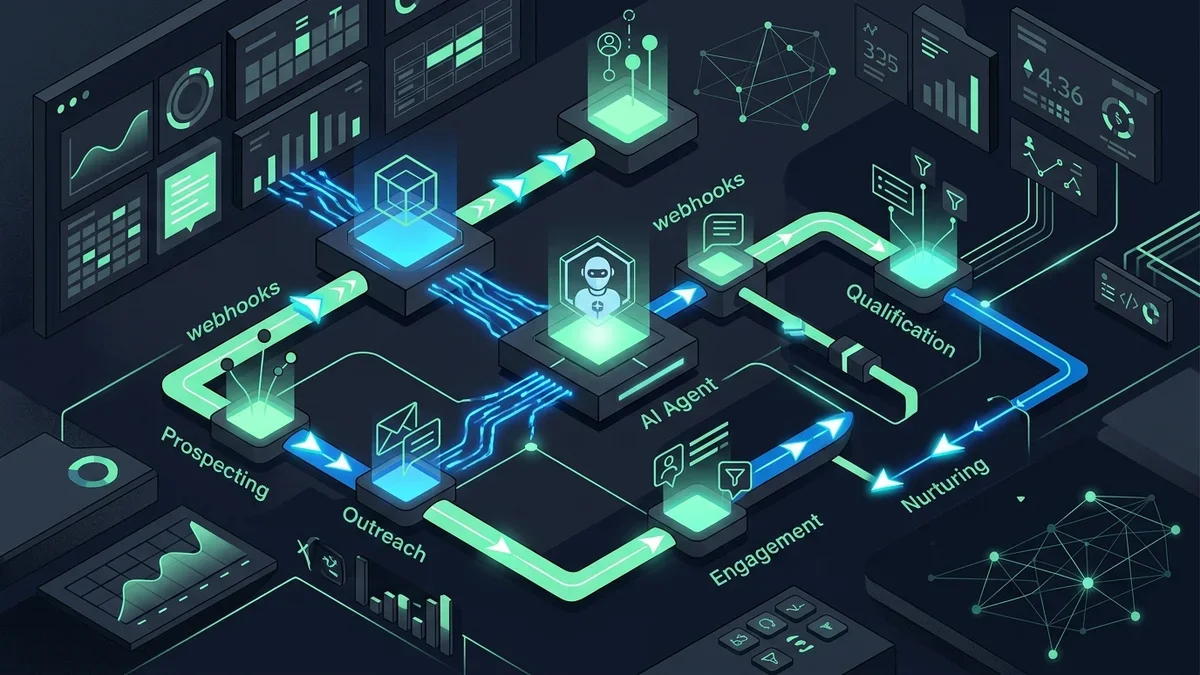
The Key Takeaway: Traditional Marketing Qualified Leads (MQLs) are a vanity metric built for human sales cycles. Autonomous GTM pipelines replace static forms and slow enrichment by deploying multi-agent orchestration layers that detect real-time behavioral signals, synthesize custom data graphs, and trigger immediate, highly contextual conversion loops.
The Rot Inside the Modern CRM
The traditional B2B marketing funnel is structurally broken. You buy a list of 10,000 unverified email addresses from ZoomInfo, pump them into an automated sequence, and celebrate a 1.2% open rate. This isn't growth marketing. It's digital waste.
Buyers do not fill out gated whitepapers anymore. They evaluate your product via vector search engines, Perplexity threads, and closed-loop community discussions long before your sales team knows they exist. By the time a lead hits your CRM as an MQL, the buying window has already slammed shut.
We are entering the era of zero-latency go-to-market execution. If your marketing stack relies on a human clicking "Export to CSV," you are already obsolete.
Anatomy of an Agentic GTM Pipeline
An autonomous GTM pipeline does not generate leads; it engineers synchronized execution graphs. Instead of linear workflows, you deploy localized LLM agents connected to real-time data APIs, vector databases, and headless browser scrapers.
1. Signal Ingestion and Vector Scoring
The pipeline monitors decentralized signals: GitHub commits, funding announcements, regulatory filings, and executive job changes. When a target account hits a threshold vector, the ingestion agent fires an API call to pull live company data rather than relying on stale static databases.
2. Dynamic Context Synthesis
Instead of sending generic templates, a worker agent analyzes the target's recent public output—earnings calls, technical blog posts, or product updates—and maps your product features directly to their immediate bottleneck.
3. Multi-Channel Execution
The output is pushed directly to an execution node that formats the outreach across the optimal channel—whether that is a programmatic LinkedIn voice note, a personalized landing page generated on the fly, or a direct API webhook into their internal developer portal.
Rebuilding Your Stack for Autonomous Conversion
Moving from campaign management to agentic orchestration requires dismantling your legacy MarTech stack. Throw out the monolithic marketing automation platforms that charge you per contact to store inactive records.
- Orchestration Layers: Use event-driven frameworks like n8n, Temporal, or LangGraph to manage stateful, fault-tolerant agent execution loops.
- Data Retrieval: Replace static enrichment with real-time web scrapers and vector embeddings that update automatically.
- Content Generation: Shift from human-written email sequences to dynamic prompt templates injecting real-time intelligence at runtime.
At the agentic marketer, we design and deploy these exact autonomous inbound funnels for tech founders via our Agentic Embed and Vibe Sprint offerings—slashing CAC while accelerating pipeline conversion.